
The Power of Regret
Regret: to feel sorry or dissatisfied about; as in to lament
“No regrets!” This is a philosophy of life for many people. n reality, I everybody has regrets. They are a fundamental part of life. What one regrets has a lot to do with what one values the most.
The Hebrew word for regret “Nacham”, conveys sorrow, and repentance. It is not just the emotion, but actions too. The opposite of regret is contentment or gratitude, where one appreciates the outcome of past decisions. In the Scriptures, we are taught to not beat ourselves up over past regrets, and instead move forward as regenerated people, having put off the old self, and put on the new self. Instead of being in perpetual emotional anguish over the regrets - we are to “arise” and 'stand up'.
Speaking of the prodigal son, Jesus said: “And he arose, and came to his father”. Luke 15:18 has the monologue of the Prodigal Son as he regrets his decisions: “I will rise and go to my father, and will say to him, Father, I have sinned against Heaven and before you.”
This is a spiritual turning point. The expression, "I will arise" is a Hebrew idiom that means beginning a new endeavor, taking action, or u initiating a plan. It signifies repentance - he left his past lifestyle and went. Even though there were a lot of regrets, the prodigal son made a decision to repent and took responsibility to return to his father. He chose to 'right' the 'wrong'. If the prodigal son had lived in a state of continuous hunger, grief and regret, he would have ruined himself, far away from his home.
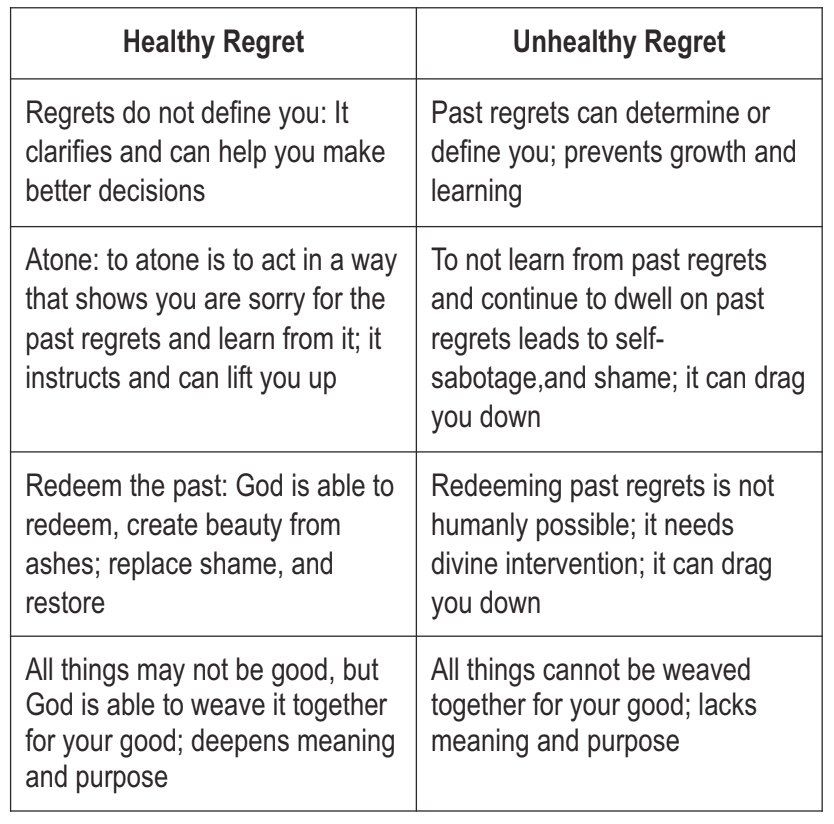
“Regret is important because when it is followed by repentance, it can be a powerful tool for positive change and growth. Continuing to live in a state of regret is unhealthy. A healthy regret can move us forward, not backward, provided we do it with compassion (Luke 15:20). Below are some differences between healthy and unhealthy regret.”
Why is Regret Important?
Regret is important because when it is followed by repentance, it can be a powerful tool for positive change and growth. Continuing to live in a state of regret is unhealthy. A healthy regret can move us forward, not backward, provided we do it with compassion (Luke 15:20).Below are some differences between healthy and unhealthy regret.
Christ re-establishes the divine order disrupted by chaos through his death on the cross by offering a path to reconciliation for those who believe. His finished work makes way for the final victory, when the earth will be finally restored to divine order (Revelation 21:1).
“In the Bible, true regrets lead to repentance; that is, to change one’s way of thinking. Repentance is critical because it enables one to experience forgiveness, restoration, and a renewed sense of purpose. Consider the life of Moses. He was forty years when he left Egypt, he spent another forty years in uncertainty as a shepherd in Midian. He was about 80 when he was called by God to rescue Israel from Egypt (Exodus 7:7). Though there were regrets, it was not wasted.”
How to have a Healthy Relationship to Regret?
When handled truthfully and honestly, one can be redeemed, restored and transformed from past regrets(Exodus 6:6-8). For example, regret is usually a retrospective emotion that happens by looking backward. But we can also cultivate a healthy regret pro-actively by predicting what we will regret, and then reorient our behavior based on our past.
Here are some ways to have a healthy relationship to regret:
Change Your Lens: view Regret as a Catalyst to Learn
Regrets of the past can be viewed as opportunities for learning and growth rather than sources of criticism or guilt. For example, instead of focusing on what could have been, one can focus on what was learned from the experience. The goal is to not get stuck in “what if” and “if only”.Once you let go, you become bolder. The Bible says that God has not given us a spirit of fear, but of power, love and a sound mind (2 Timothy 1:7). God is always weaving all things to work together for the good of those who love God (Romans 8:28).
Knowing or Anticipating What can Cause You Regret
Knowing or anticipating what can cause regrets can be a strong motivator to take certain actions or avoid others that could lead to more regrets. When facing a decision, one can anticipate what can cause regret and include in one’s choices the desire to eliminate or reduce the possibility of regret (Psalm 51). By consciously knowing or anticipating the regret and avoiding choices that lead to regret, one can use the feedback loop to make decisions. The Prodigal son anticipated the regret of not having food to eat, having to live with the pigs, being financially broke, far from home, and that led to his decision to go back home to his father.
Face your Regrets
Face the regret and make a note of what your regrets are, what you would do differently and act on it. In the Bible, Christ is able to forgive and redeem us from mistakes. God is in the habit of creating beauty from ashes, nothing is beyond redemption (Isaiah 61:3). For example, both Peter and Judas Iscariot knew Jesus well, and yet betrayed him. Peter chose to repent of the past regrets and follow Jesus. Judas on the other hand, lacked the judgement to repent of the past regrets and as a result ended his life. Facing your regrets offers us the ultimate redemption.
Regret is a necessary part of true repentance and salvation. It leads to outward and inward growth and transformation.
Horatio Spafford was a wealthy Chicago lawyer in the 1860s. He lost his fortune when the Great Chicago Fire happened in 1871 and his four-year old son from scarlet fever. The family was under a lot of died stress and his wife was so overcome with grief that he decided to send his wife and four daughters to England. The S. S. Ville de Havre ship his family was traveling on was involved in a terrible collision on l November 22, 1873 and sank in 12 minutes. All four of his daughters died along with more than 200 people. Spafford went to see his grieving wife. Later that night, he wrote the hymn: ‘It is well with my soul’.
“‘It is well with my soul’
-Horatio Stafford
When peace like a river, attended my way,
When sorrows like sea billows roll;
Whatever my lot, Thou has taught me to know,
It is well, it is well, with my soul.
Though Satan should buffet, though trials should come,
let this blest assurance control:
that Christ has regarded my helpless estate,
and has shed his own blood for my soul”
